What this tool estimates
Given pool volume (gallons) and a target change in ppm (or a small pH nudge), you can rough out how much of a common balancer or shock you might need. Use the interactive calculator above — then retest.
What you must test first
- Current free chlorine, pH, and alkalinity as relevant
- Approximate volume in gallons
- Product strength on the label (not a generic internet number alone)
How to use the results
Treat any calculator output as a starting point. Add chemical carefully, wait the label’s contact time, retest, and only then decide on a second dose.
Safety disclaimer
Never mix different chlorine products dry or in a bucket. Never pour shock through a skimmer that feeds an automatic chlorinator. Add chemical to water when pre-dissolving, not water to chemical. Gloves and eye protection are not optional.
When to retest after dosing
Retest windows depend on what you added and how. As a rule of thumb:
- pH adjuster (muriatic acid, dry acid): wait 30 minutes of circulation with the pump running, then retest.
- Alkalinity increaser (sodium bicarbonate): dose in small slugs across the deep end, brush to dissolve, retest after 4–6 hours of circulation.
- Calcium hardness increaser: retest after 24 hours — it dissolves slowly and can read low even when fully added.
- Liquid chlorine or cal-hypo shock: retest FC after 8 hours of sun-down circulation (longer in full sun).
- Cyanuric acid (stabilizer) granules: retest CYA after a full week of circulation; it can take that long to fully dissolve.
If a second dose is needed, run the calculator again with the new current reading — never stack a second dose onto the first calculation without retesting.
Common mistakes that throw off the math
A calculator is only as accurate as the inputs. The most frequent sources of error we see:
- Volume over- or under-estimate. Rectangular pools are easy; kidney, L-shape, or raised spas are not. If you’re unsure, use the pool volume calculator for a fresh reading rather than guessing.
- Stale test strips. Strips older than 6 months, or stored in a humid garage, drift. A fresh bottle of quality strips (pool test strips) costs less than redoing a dose.
- Adding before the previous dose equilibrates. Especially with CYA and calcium, partial readings mid-cycle lead to over-dosing on the second round.
- Ignoring water temperature. Muriatic acid dosing changes slightly with temp, and algae reacts faster in warm water — adjust your expectations, not the math.
- Salt systems. For a SWG, target ppm is set by the cell manual, not generic internet advice. See saltwater basics.
Volume calculator limitations
No online volume calculator replaces a true measurement. Limitations to know:
- Shape approximation only. Most calculators model your pool as a rectangle, oval, or kidney. Freeform pools and attached spas can be off by 10–20%.
- Depth is the weakest input. Few pools are truly uniform depth. If yours slope from 3 ft to 8 ft, enter 5.5 ft as the average — not the deep end.
- Unit conversions matter. Gallons vs liters swaps the answer by 3.785×. Verify the calculator is using the units you intend.
For pools with attached spas, raised walls, or vanishing edges, consider a professional measurement. The dose difference between a 12,000-gallon and a 15,000-gallon pool is 25% — large enough to matter for any chemical.
What the calculator can’t know for you
Four things change the answer after the math runs, and none of them live in the formula:
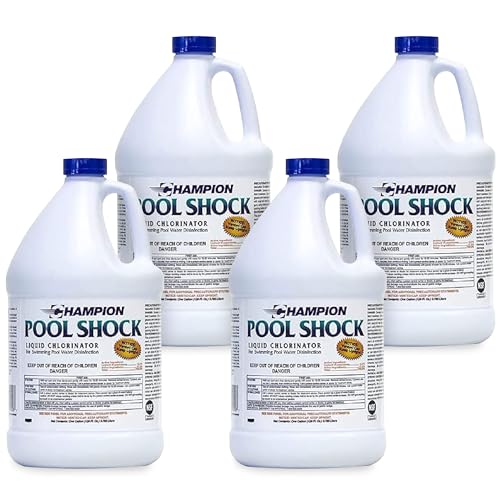
- Label strength versus active ingredient. A jug labeled 12.5% sodium hypochlorite isn’t 12.5% available chlorine. Check the label for the concentration you actually have, and whether it’s trade strength (roughly 10%) or retail strength (roughly 12.5%).
- Water temperature. Warm water burns off free chlorine faster than cool water. A dose sized for an 80°F pool won’t hold the same level in 92°F water.
- Your volume estimate. Most home pools are off by 5-15% on volume, and the dose error lands on exactly the same percentage.
- Side effects. Cal-hypo adds calcium every time you use it, so a shock dose can push calcium hardness out of range and cloud the water. Liquid chlorine leaves calcium alone.
A worked example
Say your 15,000-gallon pool reads 1.0 ppm free chlorine and you want to reach 4.0 ppm. The gap is 3 ppm.
For a 12.5% liquid chlorine, the label math works out to this:
3 ppm x 15,000 gallons / (12.5 x 10,000) = 0.36 gallons, or roughly 1.4 quarts
That’s a starting point, not a license to dump it in at once. Split the amount, add it with the pump running, and retest before the second part goes in.
Cal-hypo is dosed in pounds instead, and it raises calcium hardness as it goes, so recalculate from that label rather than reusing the liquid-chlorine number. And never combine two chlorine products in the same bucket or the same pour. Mixing them releases a dangerous gas.
Dosing order changes the result
The same water can need three different chemicals depending on where it sits:
- Alkalinity first. Below roughly 80 ppm, pH swings hard and no dose stays put.
- pH second. Free chlorine does its work around 7.2-7.8. Above that range, sanitizer demand climbs fast.
- Calcium and sanitizer last. Once the water is balanced, sanitizer can do its job and you judge the result by retesting instead of guessing.
When the result looks wrong
If the pool doesn’t respond the way the calculator predicted, work through this list before you dose again:
- Re-test with fresh strips. Vivid strips lose potency once the bottle has been open for months.
- Re-check the volume. A 10% volume error is a 10% dose error.
- Check the label. Different brands and different strengths don’t share a math.
- Account for what changed. Rain and top-offs dilute the water, and a heavy bather load consumes sanitizer faster than you’d expect.