Quick answer
Cloudy pool water means the filter can’t catch fine particles fast enough — usually a tired filter, an out-of-range pH or TA, low free chlorine, or pollen and dust after rain. Test pH, TA, and FC first; then run the pump 8–24 hours, backwash the filter, and dose a clarifier. Severe cases use flocculant and vacuum to waste. Most cloudy pools clear in 24–48 hours once the cause is fixed. Solidly green? Jump to the green-pool hub.
What cloudy pool water actually looks like (and what it isn’t)
If you walk out to milky, hazy-green, or dull water with a fuzzy bottom, that’s a fixable problem. Done wrong, you waste money on the wrong chemical; done right, it’s a 24–48 hour sequence: test, run the pump, fix what’s off, dose a clarifier.
The first split is by sight — pick the one your pool looks like most, because the fix is different for each. Test numbers still decide the dose.
Milky / dusty / chalky white
Water looks like diluted milk — you can see the bottom, but a haze softens every line. Almost always a filter problem or high TA / high pH, not algae: old sand or DE, a pump running too few hours, or TA above 150 ppm.
Green cloudy water
Water has a definite green tint and looks pea-soup-like. This is low free chlorine plus algae starting up, OR dead algae after a recent shock that hasn’t filtered out yet. If FC reads 0 and water is green, that’s an algae bloom — the green-pool hub is the right stop. If FC is fine and the water is hazy green, you have dead algae to vacuum out.
Hazy / blue-tinted but transparent
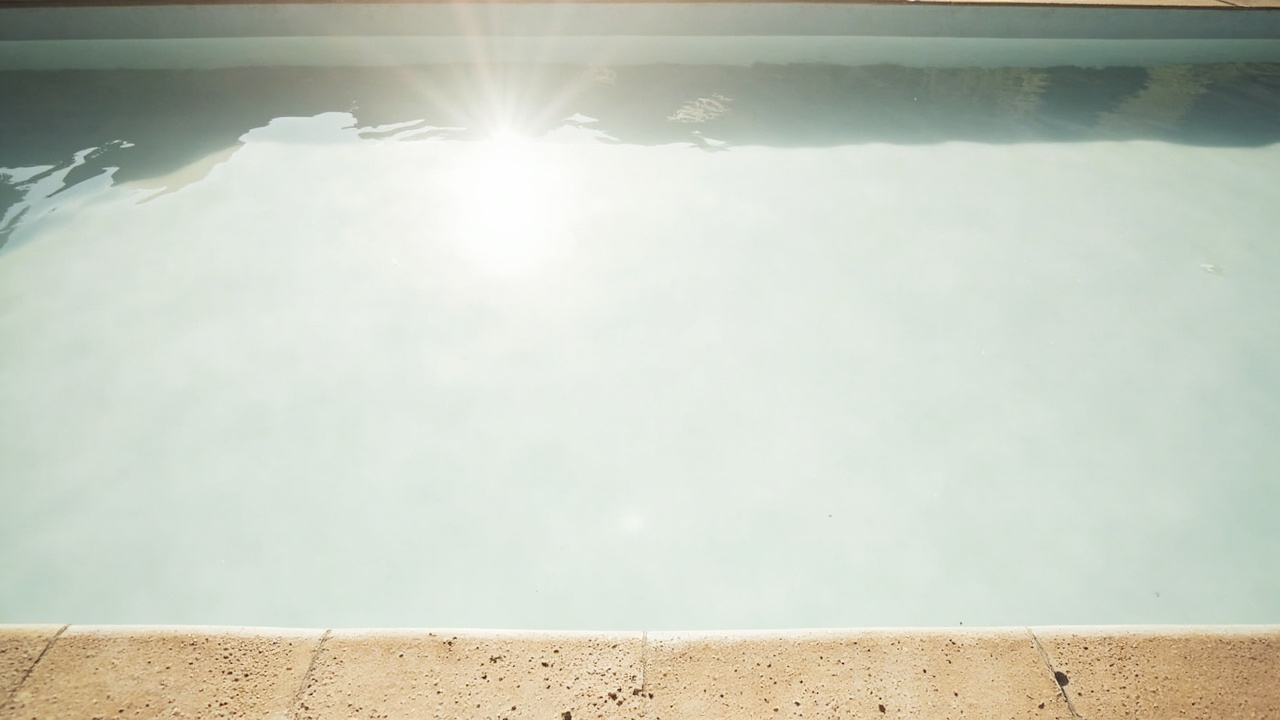
Pool looks clear, but a white object on the bottom looks fuzzy. It’s fine particles the filter can’t catch — pollen, dust after rain, calcium micro-precipitate, early dead-algae breakdown. Most pools clear in 24 hours of filter time.
What this is not
Cloudy pool water is its own problem. Don’t confuse it with:
- Solidly green pool water — that’s algae, owned by the green-pool hub. If green is the dominant color, jump there.
- Calcium scale or white flakes on tile — that’s high TA / high CH, owned by total alkalinity and the calcium-hardness section of pH. Scale sits on surfaces; cloudiness floats.
- Metal staining (teal / brown / black on walls) — that’s copper or iron; stains don’t move, cloudiness does.
- Foam at the waterline — that’s surfactant residue (lotions, algaecide overuse).
Why pool water turns cloudy (9 typical causes)
The nine most common cloudy-pool causes, in order of frequency:
Filter problem diagnosis
The filter is the most common reason a pool goes cloudy. Old sand (3+ years), clogged DE grids, torn cartridge, or a pump running fewer than 8 hours a day — half of all cloudy pools are filter problems first. Read the filter’s pressure gauge; if it sits 8–10 psi above your clean baseline, the filter is loaded and needs a backwash. If backwashing doesn’t bring the pressure back down, the media is dead.
Chemistry imbalance diagnosis
Five chemistry issues cause cloudiness without any algae:
- High TA / high pH — pH above 7.8 and TA above 150 reduce chlorine’s killing power and let scale form. The fix is in the pH guide (acid dosing) and TA guide (aeration or staged acid).
- Low free chlorine — below 3 ppm, algae gets a foothold. Cloudy is the warning sign before green takes over. See the FC guide for breakpoint dosing.
- High CYA — above 100 ppm, chlorine is over-stabilized and ineffective regardless of dose. Drain and refill part of the pool.
- High calcium hardness — CH above 400 ppm (plaster) is scale-forming; the fine haze clouds water and plates a salt cell. Fix with a partial drain or CSI-aware balancing.
- High TDS — TDS itself rarely clouds water, but 1,500+ ppm above your fill water means old water: corrections stop holding, and a partial drain resets it.
Other causes, in order:
- Dead algae after a recent shock — the kill worked but the debris hasn’t filtered out yet. Vacuum and backwash; the cleanup timeline has its own section below.
- After rain / pollen / dust — environmental debris. Run pump + backwash.
- New plaster or new fill water — first 30 days of a new plaster pool or after a refill, calcium raises TA. Use the chemical dose calculator to track.
- Heavy bather load (oils, lotions) — body oils emulsify and scatter light. A weekly enzyme clarifier breaks them down. First-year owners following the weekly care rhythm avoid this by adding the clarifier on the same day each week.
Decision tree: which cloudy type you have and what to do first
Use this to pick a path. Test FC, pH, and TA first; you need those numbers before any decision. Don’t dose anything blind.
- Branch A — Test passes but water is milky: filter problem, not chemistry. Backwash the filter (sand or DE) or rinse the cartridge. Run the pump at least 8 hours a day — 24 for active clearing. If the sand or DE is 3+ years old, replace the media before adding more clarifier. Add a clarifier at the bottle dose; it clumps fine particles so the filter can grab them. Still milky after 48 hours means the filter itself is failing.
- Branch B — Test shows high TA (above 150 ppm): lower TA first — high TA pins pH high, and high pH makes chlorine weak. Use dry acid or muriatic acid; aeration alone is too slow above 150. See the total alkalinity guide for the full procedure. Retest TA after 24 hours, then pH — the TA correction often brings pH back on its own.
- Branch C — Test shows high pH (above 7.8): lower pH with dry acid or muriatic acid per the pH guide. At pH 7.4–7.6, recheck FC and top up if it dropped.
- Branch D — Test shows low FC (below 3 ppm): cloudy with low FC is an algae bloom starting. Shock to breakpoint (raise FC to 10 ppm for CYA under 50, or to 20 ppm for CYA 50–100). Wait — once FC is at breakpoint and the water turns fully green, jump to the green-pool hub for the full kill protocol.
- Branch E — Test shows CYA above 100 ppm: CYA caps how much active chlorine you can have; no amount of shocking keeps FC effective above it. Drain and refill part of the pool to bring CYA back to 30–50 ppm. See the FC guide for the CYA:FC ratio.
- Branch F — After rain or heavy pollen: run pump 24 hours straight and backwash the filter twice. Rain mixes surface pollen into the water; a healthy filter clears it in a day. Heavy pollen may need a second backwash the next morning.
- Branch G — No improvement after 48 hours of correct treatment: call a pro. The cause is likely mechanical (broken laterals, torn DE grid, cracked cartridge housing), and more chemicals won’t touch it.
Cloudy saltwater pools: what’s different
Salt pools go cloudy for the same nine reasons, but the failure mode that dominates the category is different: the chlorine generator.
Same tests, different failure mode
Check the cell before you blame the water. High CH and high pH scale the cell plates; a scaled cell makes less chlorine; low FC lets algae start; algae turns water hazy. That chain — not tired sand — is why salt pools cloud up with “perfect” test numbers. Check cell output first, then CH and pH, then the standard list above. CYA still matters, and salt pools want a bit more of it (60–80 ppm) — how a saltwater pool stays chlorinated explains why.
Saltwater clarifier rules
Standard clarifier can foam in a salt cell. Use an enzyme formula — the clarifier picks in the step-by-step below are already salt-rated.
How to clear cloudy pool water (step-by-step)
Three cloud types, three fix paths. Pick the one matching your visual diagnosis above and use the chemical dose calculator for any acid or shock addition. Solidly green despite the green-cloudy path? That’s an algae bloom — jump to the green-pool hub.
Step-by-step: clearing milky
Milky water is a filter or chemistry problem — no algae. The fix runs filter-first, then chemistry.
- Backwash or rinse the filter. Sand or DE filters: backwash until the sight glass runs clear. Cartridge filters: hose off the pleats top to bottom. If the sand or DE is 3+ years old, replace the media first.
- Run the pump 24 hours during clearing. Four hours a day is not enough cycles. Set a smart plug or runtime clock so the pump actually runs — it’s the cheapest tool for preventing repeat cloudiness.
- Test pH and TA. If pH is above 7.8, dose dry acid or muriatic acid per the chemical dose calculator. If TA is above 150 ppm, lower TA before you fight pH — see the TA guide.
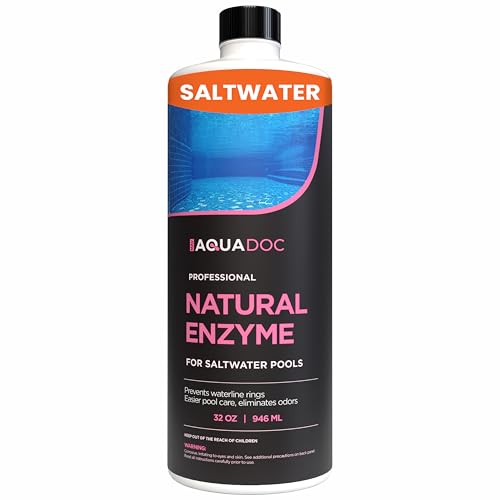
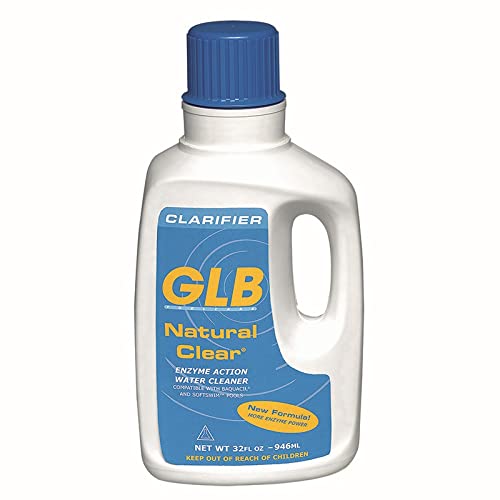
- Add a clarifier. Pour the dose around the pool edge with the pump running — not through the skimmer. Our pick for routine clarity is the AquaDoc saltwater enzyme clarifier — weekly maintenance, gentle on equipment. On a chlorine-only pool, the GLB Natural Clear Enzyme Clarifier is the pick. Allow 24–48 hours of pump runtime.
- Retest after 24 hours. pH 7.4–7.6 and TA 80–120 ppm means the water should be clearing; still milky at 48 hours points at the media.
Step-by-step: clearing green
Green cloudy water means algae is starting or dying. The fix is shock first, then clarifier to clean up dead-algae haze.
- Test FC, pH, and CYA. Don’t shock blind — match the breakpoint to your CYA level (10 ppm FC under CYA 50, 20 ppm FC at CYA 50–100). See the FC guide for the FC:CYA table.
- Brush walls and floor. Do this before shocking so chlorine reaches the algae film instead of riding over the top. A standard wall brush works fine; pool-specific stiff-bristle brushes cut the time in half.
- Shock to breakpoint at dusk. Sunlight burns off FC. Add the shock dose with the pump running. Never pour shock through a skimmer that feeds an automatic chlorinator — gas can form. Dissolve shock in a bucket and pour in front of a return jet, with the pump running. Always add chemical to water, not water to chemical.
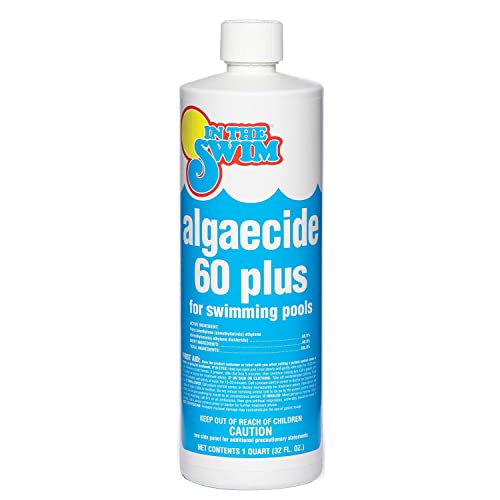
- Add algaecide (only if water is hazy green, not fully green). If FC has dropped and water is starting to turn but isn’t solidly green, an algaecide helps the shock hold the line. The In The Swim Algaecide 60 Plus is a polyquat 60 formula at the standard dose. Skip algaecide if the pool is already solidly green — shock alone is enough, and the green-pool hub covers the full kill sequence.
- Run the pump 24 hours and backwash. Filter pressure will climb as dead algae loads the bed — backwash when pressure is 8–10 psi above baseline.
- Dose clarifier after the kill. Once FC has held at breakpoint for 24 hours and water is back to blue-green, dose a clarifier to grab the dead-algae haze. The clarifier clumps fine particles so the filter can sweep them out.
Step-by-step: clearing hazy
Hazy water means fine particles the filter can’t catch — pollen, dust, calcium micro-precipitate, or early dead-algae breakdown. Clarifier handles 90% of these cases. Flocculant is for the 10% where the bottom is invisible.
- Test and rule out chemistry first. A quick FC + pH + TA check confirms chemistry isn’t the cause. If pH is high, fix it before dosing clarifier — high pH breaks clarifier’s polymer chains and the dose does nothing.
- Backwash and run the pump 24 hours. Even a hazy pool benefits from a clean filter bed and continuous circulation before adding chemistry.
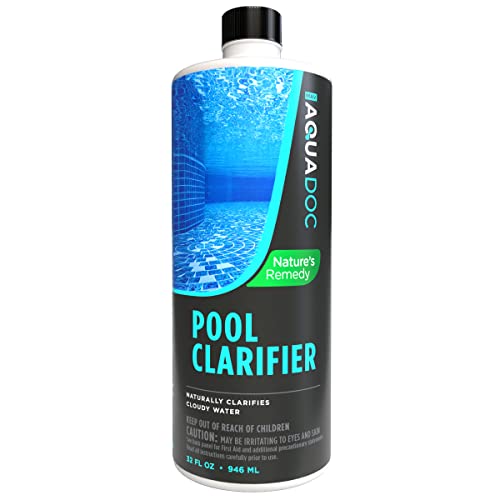
- Add a clarifier. For routine haze, pour the dose around the pool edge with the pump running. Our pick for routine clarity on chlorine pools is the AquaDoc Natural Pool Clarifier — a single bottle handles a hazy cycle on a small or above-ground pool. On saltwater, the AquaDoc saltwater enzyme clarifier is the right pick — regular clarifier can foam in salt cells. Allow 24–48 hours of pump runtime.
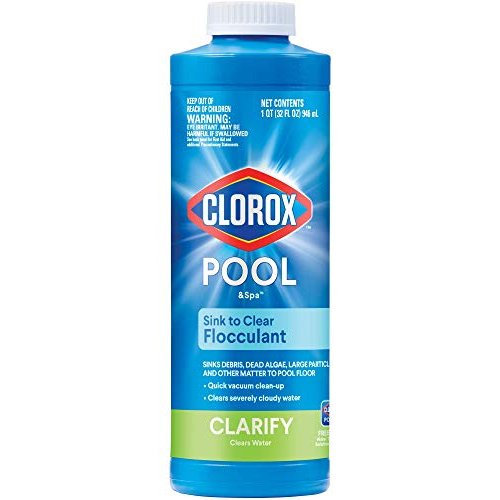
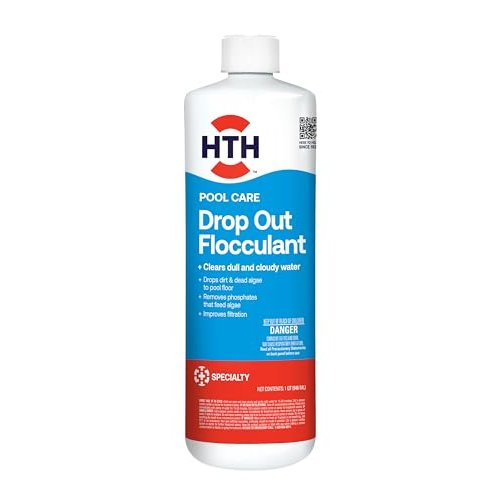
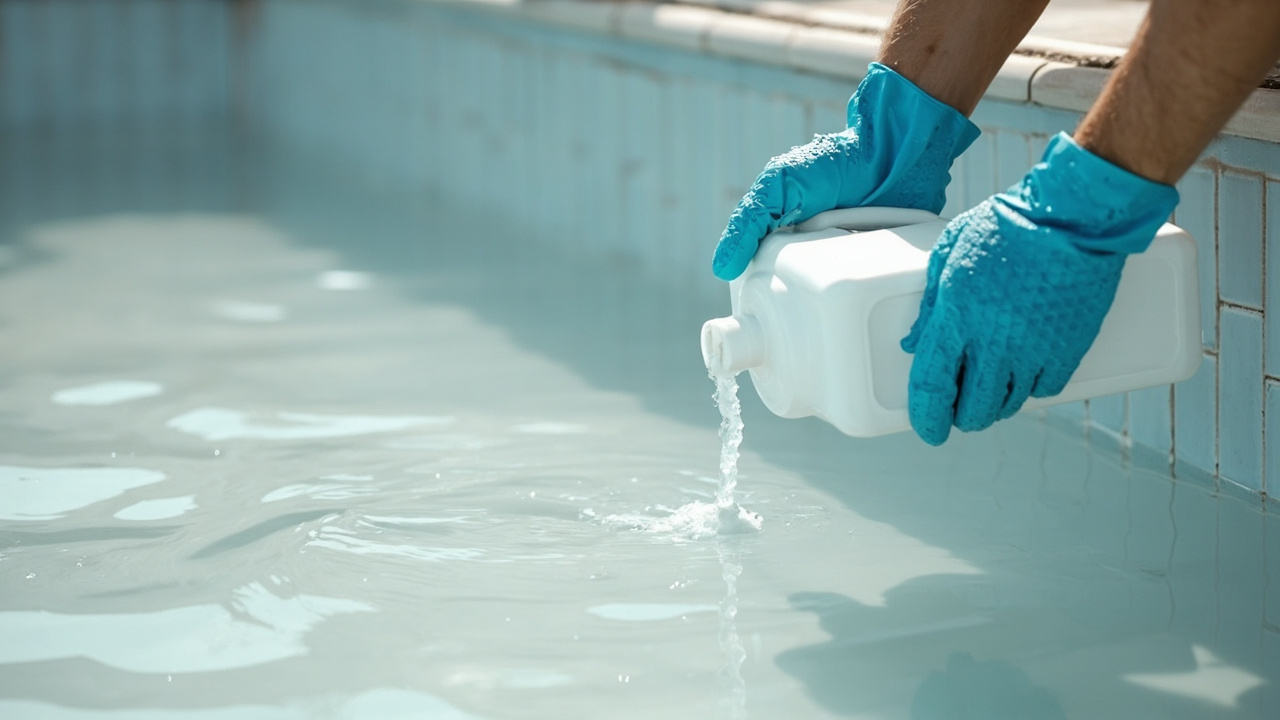
- Use flocculant only if the bottom is invisible. Clarifier won’t cut it when the water is opaque. Our pick for severe cases is the Clorox Pool & Spa Sink to Clear — pour per label, run pump 2 hours, shut it off, and let the pool sit 8–12 hours. Flocculant must be vacuumed to waste, not backwashed to the filter — it overloads the bed and cements the media. The HTH Drop Out Flocculant is the alternative if you prefer the yellow-bottle brand.
- Retest and verify. After 24 hours, FC should be 3–7 ppm and pH 7.4–7.6. If cloudiness returns within a week, your filter media is the suspect — replace it.
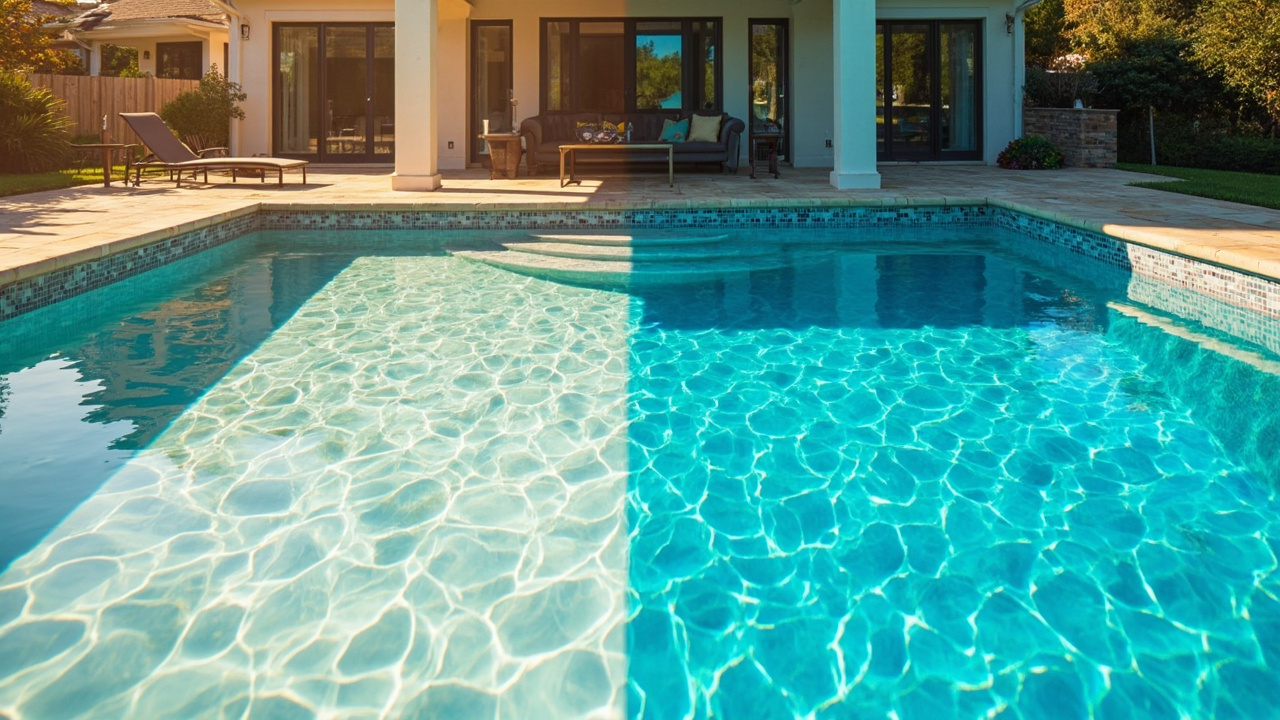
Within 24–48 hours of continuous pump runtime with the clarifier dosed, the haze should visibly drop and the water return to clear blue as the filter grabs the clumped particles. No improvement at 48 hours with chemistry in range points at the media — not the clarifier dose. The split below shows a typical result at the 24-hour mark.
Cloudy after algae treatment: the 48–72 hour cleanup
Cloudy water right after an algae kill is normal — dead algae is debris, and debris is a filtering job. Two sources, one timeline:
- Dead-algae debris — the kill worked; the haze is what’s left. Hold FC at breakpoint for 24 hours, run the pump 24 hours straight, backwash as pressure climbs; once the numbers hold, dose clarifier and vacuum what settles.
- Polyquat residue — over-dosed algaecide milks the water and foams at the returns. It oxidizes out with a few days of circulation; clarifier won’t touch it.
Not clearing? CC above 0.5 ppm or overnight FC loss over 1 ppm means the algae isn’t dead — repeat the Branch D breakpoint.
What you’ll need
- Clarifier — pick the AquaDoc saltwater enzyme clarifier for saltwater pools, or the GLB Natural Clear Enzyme Clarifier for chlorine pools without a salt cell. The AquaDoc budget-bottle clarifier is the budget pick for first-time users or small above-ground pools.
- Flocculant — only if water is so cloudy you can’t see the bottom. Clorox Pool & Spa Sink to Clear or HTH Drop Out Flocculant.
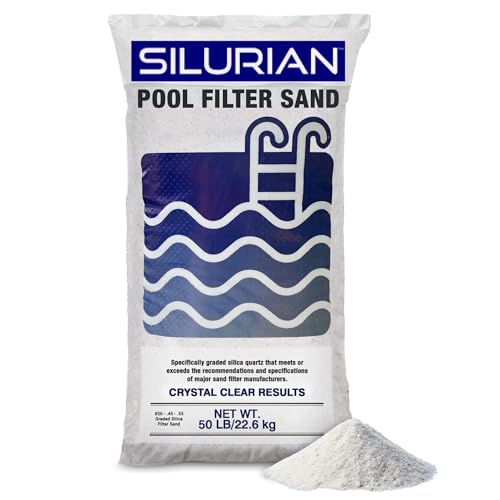
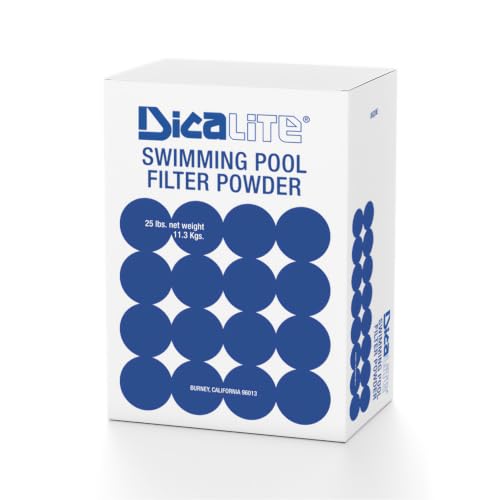
- Filter media — U.S. Silica #20 grade silica filter sand for sand filters; Dicalite DE25BOX for DE filters. Replace sand every 3–5 years, DE after every backwash.
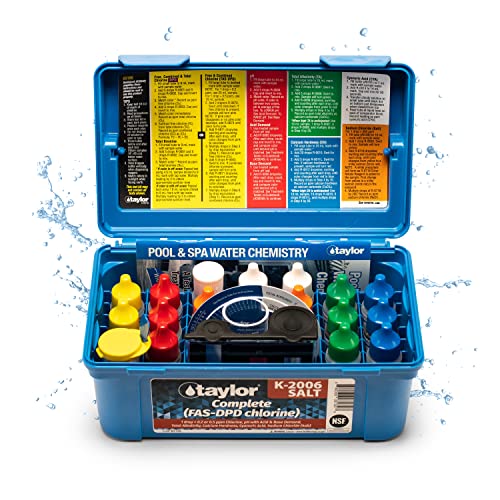
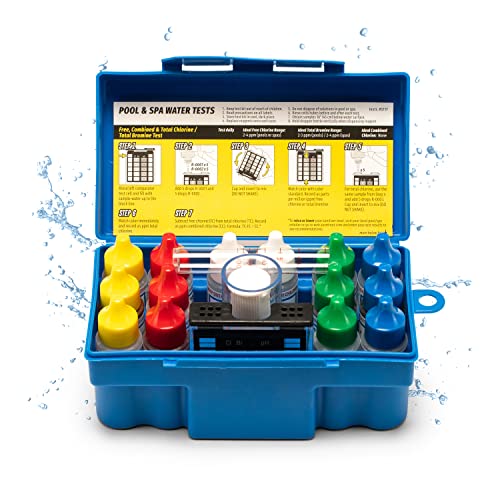
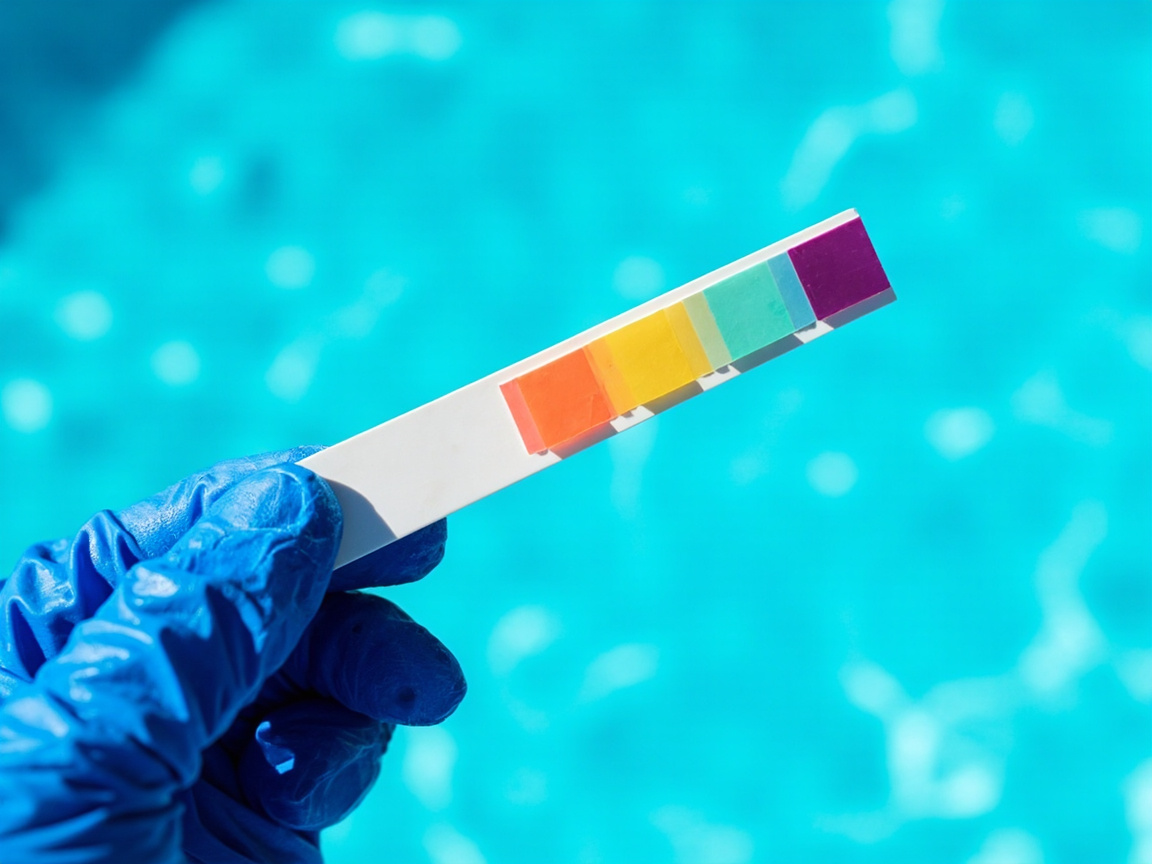
- DPD test kit — Taylor K-2006-SALT is the gold standard (FC accurate at high CYA); Taylor K-1005 is the budget option for weekly reading. Cheap strips read FC wrong above 5 ppm and miss iron and copper — see common mistakes below.
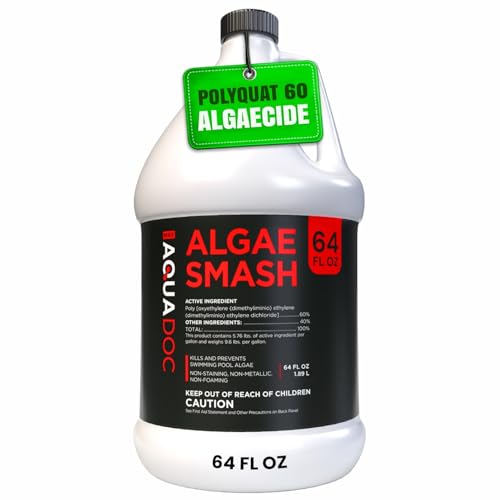
- Algaecide — only for the green-cloudy branch. In The Swim Algaecide 60 Plus for the standard dose; AquaDoc Algae Smash for larger pools.
- Pump runtime clock or smart plug — so you actually run 8–24 hours.
What to buy only if needed
Only if filter sand or DE is 3+ years old
Old media physically won’t catch fine particles no matter how long you run the pump. Don’t add more clarifier and hope — replace the media. For sand filters, U.S. Silica #20 grade is the right size; Dicalite DE25BOX for DE filters.
Only if FC reads 0 and water is green
You are not in cloudy-land — you are in algae-land. Buy algaecide plus shock, then jump to the green-pool hub for the kill sequence. Clarifier does not kill algae.
Only if CYA is over 100 ppm
Stop adding stabilized chlorine (trichlor / dichlor). Buy a CYA reducer or drain and refill part of the pool. Until CYA is back under 50 ppm, no shock will keep the water clear.
Only if you’re on a saltwater pool
Use a saltwater-rated enzyme clarifier — the AquaDoc saltwater formula — regular clarifier can foam in salt cells. Full saltwater sequence above.
Common mistakes
- Trusting cheap test strips alone — they read FC wrong above 5 ppm, miss iron and copper, and give no CYA number you can trust. A DPD-based kit is the fix. For a side-by-side of strips vs liquid kits vs titration, the essentials pool testing hub lays out which kit fits which owner. The Taylor K-2006-SALT reads FC accurately at high CYA and is the kit pool-service pros use. This is the single most expensive mistake in pool care. A weekly clarifier on the same day each week prevents most repeat cloudiness.
- Dosing clarifier into a green pool, or pouring shock through the skimmer with an automatic chlorinator downstream — clarifier clumps particles but doesn’t kill algae, and shock through a skimmer risks chlorine gas forming. Always dissolve shock in a bucket and pour in front of a return jet.
- Running the pump 4 hours a day and expecting clarity — most cloudy pools need 8–24 hours of pump runtime during clearing. Four hours isn’t enough cycles for the filter to grab fine particles.
- Re-dosing clarifier when it doesn’t work — if 24 hours of clarifier + filter didn’t help, the filter media is dead (or you backwashed DE back into the pool). Replace the media; don’t add more chemistry.
When to call a pro
Keep DIY if — you can test water, brush the walls, run the filter 24 hours, and the numbers are moving in the right direction.
Call a pro if:
- Pump or filter won’t prime, or you hear grinding from the pump motor
- Filter sand has hardened or channels form in the bed (broken laterals)
- Cloudiness persists after a full clarifier cycle (48 hours) with good numbers
- Water is solidly green after shocking — full algae bloom, not just cloudy
- You see metal staining appearing alongside the cloudiness (copper / iron)
- You’re not comfortable handling muriatic acid for a TA drop
A service call is cheaper than replacing a cracked filter tank or ruined heater exchanger.
Safety notes (read this)
- Never mix chlorine products dry or in a bucket — explosive reaction risk.
- Never pour shock through a skimmer that feeds an automatic chlorinator — gas can form.
- Add chemical to water, not water to chemical, when pre-dissolving in a bucket.
- Gloves + eye protection when handling dry acid, muriatic acid, or shock.
- Flocculant must be vacuumed to waste, not backwashed to the filter — it overloads the bed.
- Store all pool chemicals locked away from kids and pets, dry, and ventilated.
Related
- Pool water testing — DPD vs strips vs liquid, test frequency, and the FC + pH + TA + CYA sequence.
- Green-pool recovery path — full algae kill protocol when FC has dropped to zero.
- Pool free chlorine — match FC to your CYA and shock to breakpoint.
Key takeaways
- Three cloud types — milky (filter), green-cloudy (algae starting or dying), hazy (fine particles) — need three different fixes.
- Always test FC, pH, TA, and CYA before dosing anything.
- Run the pump 8–24 hours during clearing; 4 hours a day is not enough.
- Clarifier is routine; flocculant is severe and requires vacuum-to-waste.
- If filter sand or DE is 3+ years old, replace before adding more chemicals.
- Cheap test strips miss iron / copper and read FC wrong above 5 ppm — use a DPD kit.
- Solidly green = green-pool hub. Milky or hazy = cloudy-pool hub.